
Delaware Criminal Court Records
Delaware criminal court records hold the full story of a criminal case. Arrest details, charges, pleas, trial events, and final orders all sit in the court file. You can search Delaware criminal court records through a few routes. Most people start with the state court system, then move to the county clerk for the full file. Police records units and the State Bureau of Identification round out the picture. This page shows where to look, who to call, and which forms to use. Read on to find case dockets, court files, and certified criminal history reports fast.
Delaware Criminal Court Records Overview
Where to Find Delaware Criminal Court Records
The Delaware Courts system uses a three-tier pyramid. Justice of the Peace Courts sit at the base and hear minor crimes, traffic matters, and landlord-tenant cases. The Superior Court sits in the middle and hears felony cases. The Supreme Court sits at the top and hears appeals. Each layer of this system keeps its own case files. When you want Delaware criminal court records, the court that handled the case is the place to start.
Most Delaware criminal court records live in paper files at the courthouse. The Office of the Prothonotary in each county runs the criminal file room. You file Form ADM_ADM_03_A to ask for Superior Court criminal files. Form MISC35 covers Justice of the Peace Court access. Staff can pull a file for you, but you must review it at the courthouse. Files cannot leave the building. Copy fees start at $2 per page for plain copies and $15 for the first three certified pages.
For a record outside the courthouse, the State Bureau of Identification issues certified criminal history reports. These reports come from fingerprints, not name searches. Fingerprint locations sit in Wilmington, Newark, Middletown, Dover, Milford, Georgetown, and Seaford. Fees run $72 for a state-only report. A state plus federal report costs $85 and needs a legal mandate.
Lead-in image below links to the main Delaware Courts portal, which is the best first stop for any court record task.
The Delaware Courts official website is the home page for all three court tiers.
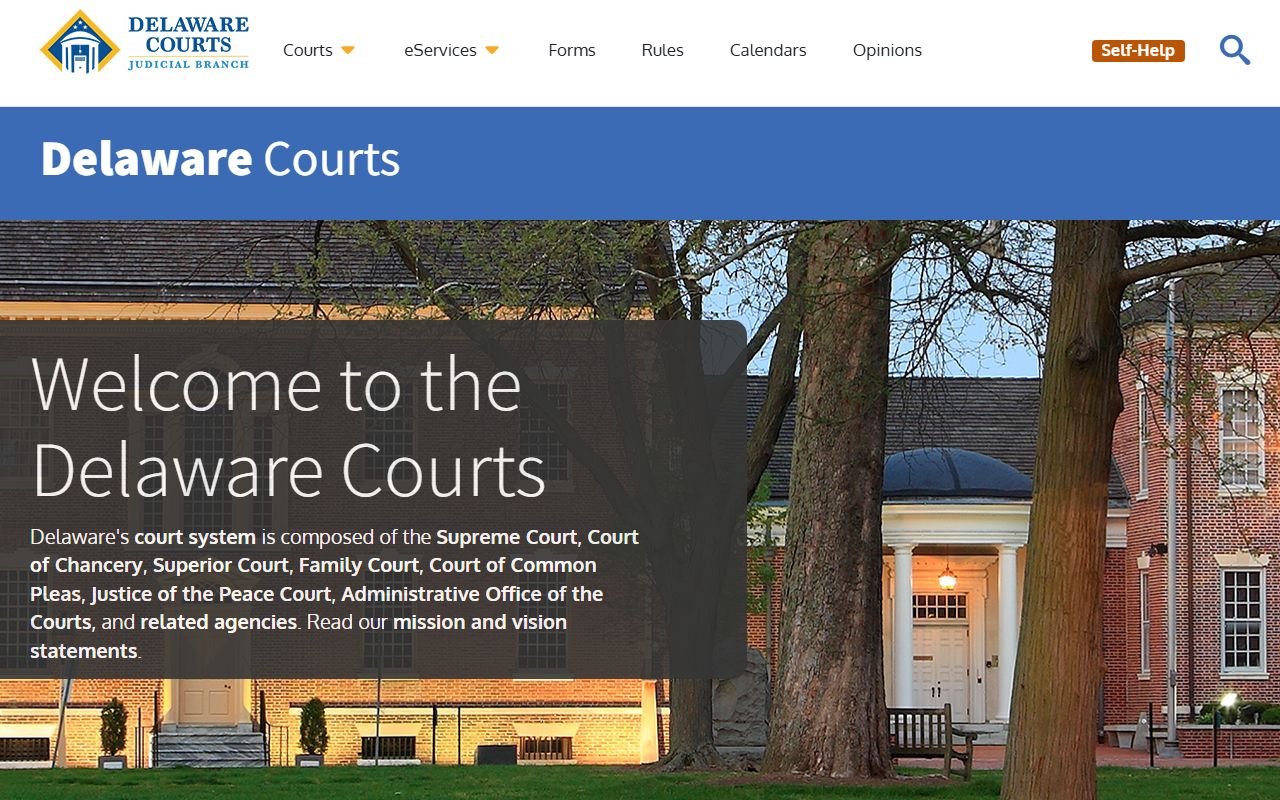
The portal links out to court locations, forms, rules, and case search tools. You can find the right form for a records request here.
Search Delaware Criminal Court Records Online
Online search for Delaware criminal court records has one big limit you must know. CourtConnect, the main state case search, does not show criminal case details. It shows civil cases, judgments, and docket reports for civil matters across Superior Court, Court of Common Pleas, and Justice of the Peace Court. Criminal case files are not on the portal. For the criminal case, you still call or visit the courthouse.
Take a look at the CourtConnect civil case search to see what is online today.
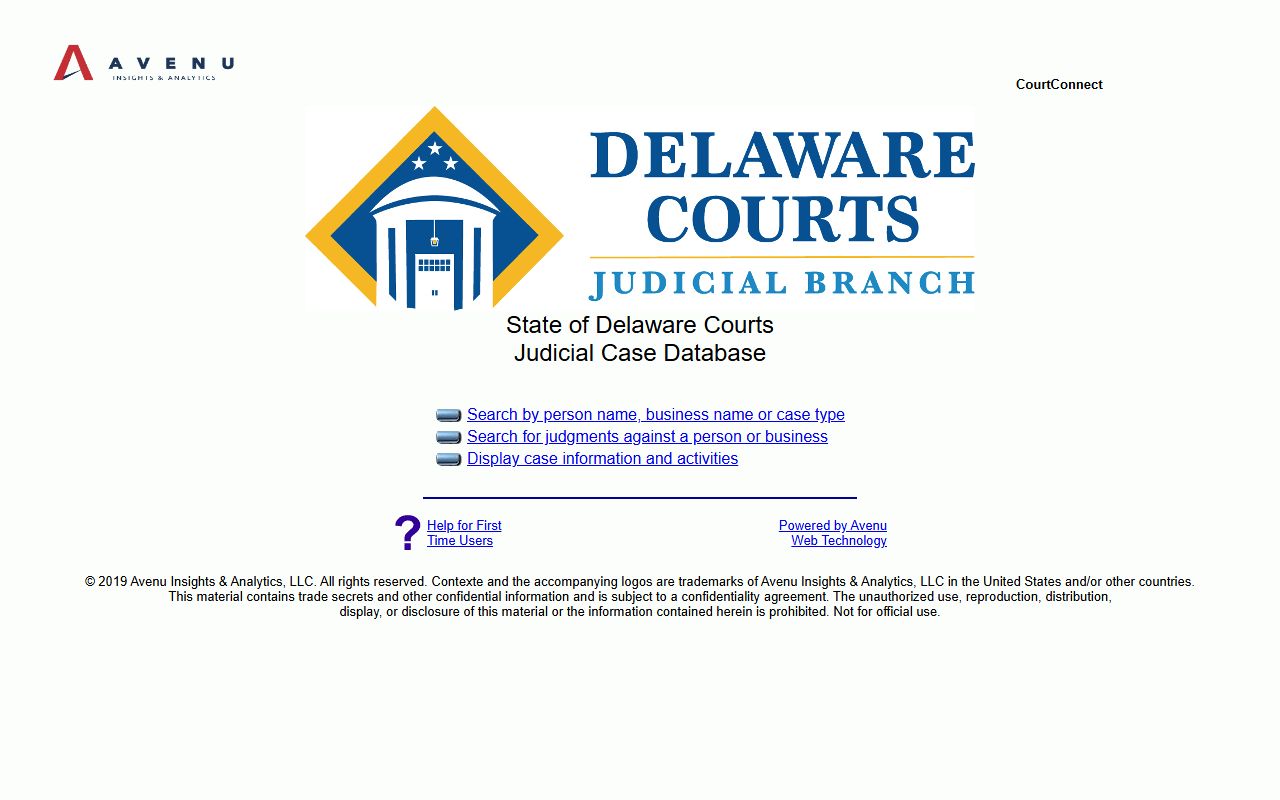
CourtConnect handles person name, business name, and case type searches. Results show the case style, case number, party role, and filing date.
Why does this matter if you want Delaware criminal court records? Two reasons. First, many criminal defendants also have civil judgments on file. A CourtConnect search can turn up child support orders, protective orders, or civil judgments tied to a criminal case. Second, the case number format helps you ask for the right file at the courthouse. Superior Court cases use a format like S22C-01-001. Court of Common Pleas cases use CP22001. The clerks use these numbers to pull criminal files too.
The civil docket search page is a second way to view the same data.
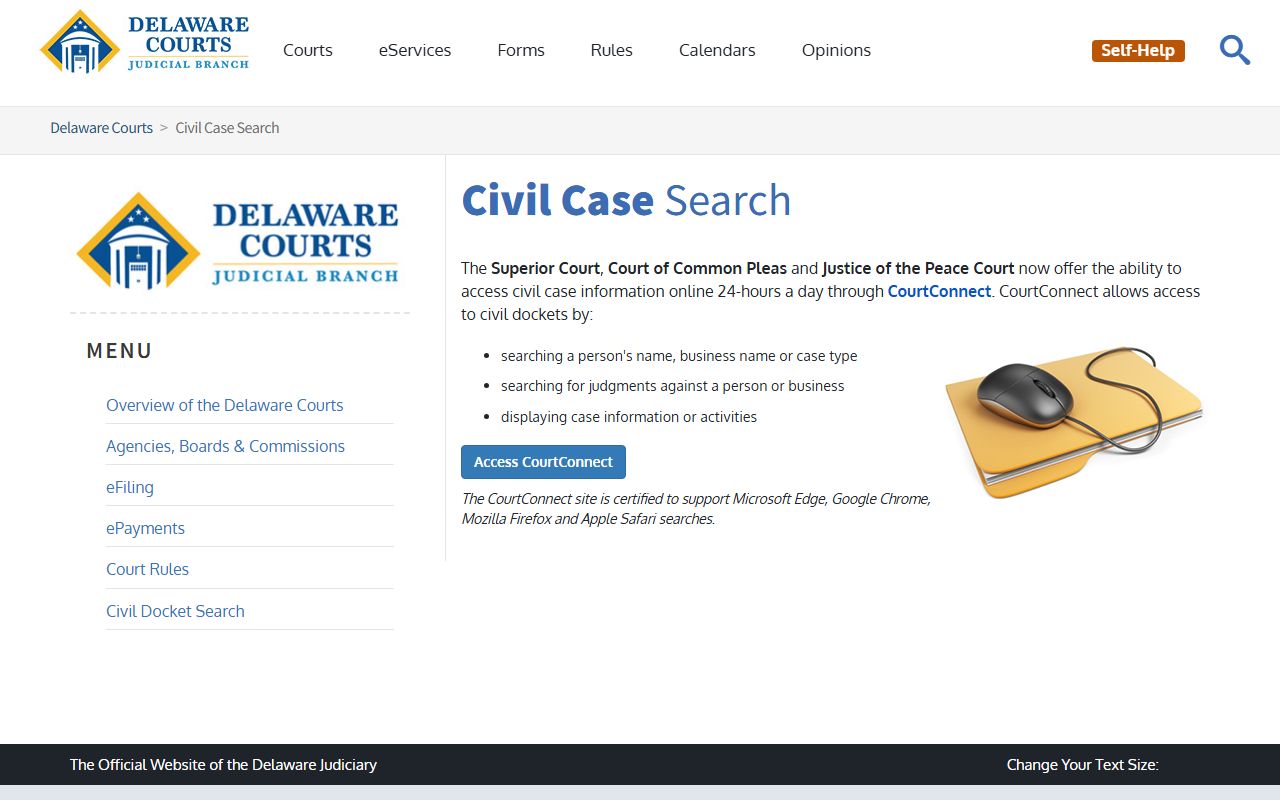
This search runs 24 hours a day. Read the Terms of Use, accept, and then search by name or case type. You can print or save results for your records.
Phonetic search helps when you are not sure how a name is spelled. Partial last name search casts a wider net. Both tools can point you to a case you might miss with an exact match. No fee, no login. The Avenu Insights & Analytics firm runs the system under a contract with the courts.
Note: CourtConnect is civil only. For Delaware criminal court records, you must ask the Prothonotary at the courthouse where the case was heard.
Delaware Criminal Justice Information System
The Delaware Criminal Justice Information System (DELJIS) is the state's main criminal history repository. DELJIS holds the official record under Title 11, § 8605 of the Delaware Code. The office sits at the Carvel State Office Building, 820 N. French Street, Wilmington. Phone is 302-577-8787. A second office is at 800 Silver Lake Blvd, Dover.
The DELJIS home page shows what the public can access.
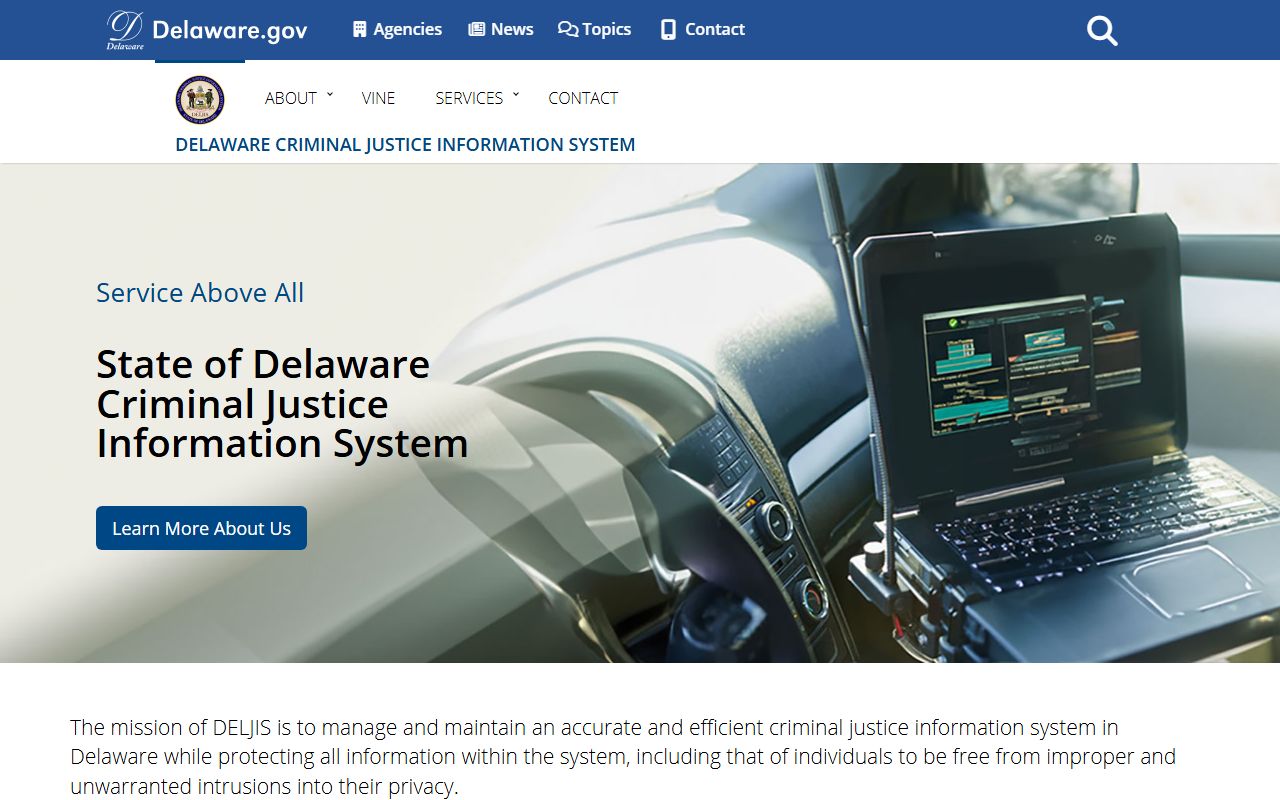
Full access needs law enforcement credentials. Members of the public get limited access through linked portals like the wanted persons search and the VINE victim notification tool.
DELJIS also runs the ePayment portal for traffic tickets. Juvenile records get stronger privacy rules under Title 10, Chapter 9. Sealed and expunged records stay in DELJIS for official use, but the public cannot see them.
Certified Criminal History from Delaware State Police
When you need a certified criminal history, the Delaware State Police State Bureau of Identification is the right stop. Each request uses fingerprints. Name-only checks do not produce a certified report. The state uses IdentoGO to set up fingerprint appointments at nine sites across Delaware.
The State Bureau of Identification page lists fees, service codes, and site hours.
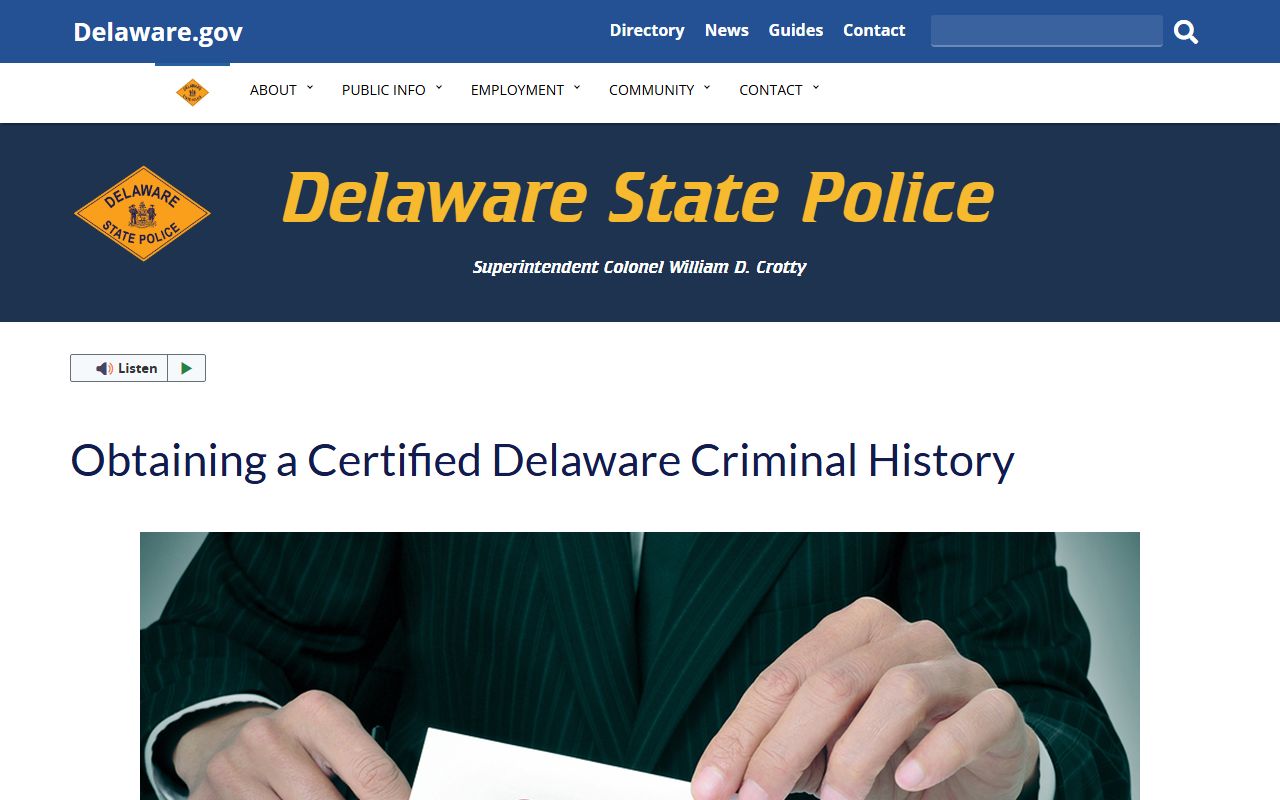
Bring a valid driver's license or state ID to your appointment. Walk-ins are not offered. Most results come back by mail within two to four weeks.
A few service codes cover most public uses:
- 27RVGT for a personal criminal history request
- 27S23V for an expungement application background check
- 27S8N2 for a handgun qualified purchaser permit
- State only report: $72
- State plus federal report: $85 (needs a legal mandate)
The Sex Offender Registry is also on the DSP site. Visit sexoffender.dsp.delaware.gov to look up a name. Data gets updated on a set cycle. Address and tier level both show in the results.
Wanted Persons and Active Warrants
The Delaware State Police keeps an online wanted persons list. The list helps the public help the police find fugitives. Search by name, photo, or offense type.
The DSP wanted persons page shows current photos and charges.
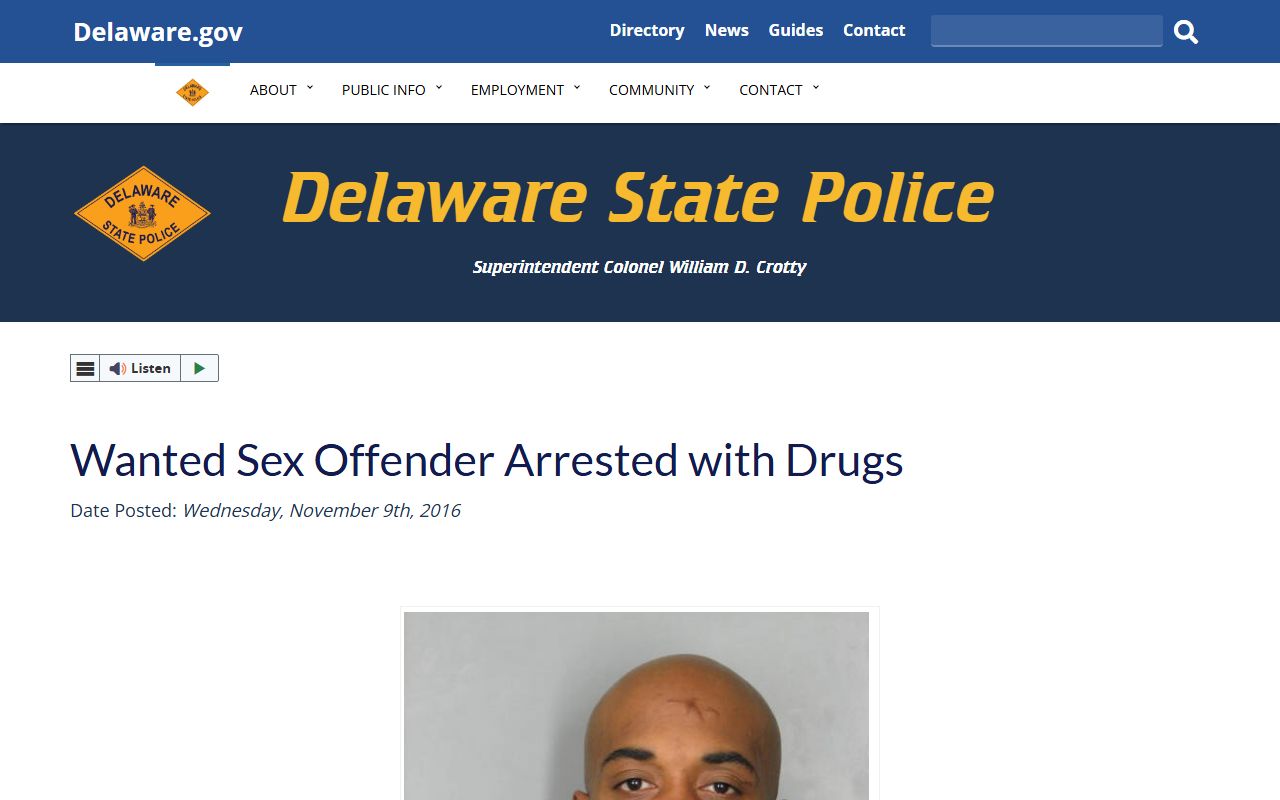
Do not try to stop a wanted person yourself. The page has a tip line for sightings. Tips can be anonymous. Some cases carry a reward.
Wanted lists are not the same as a court record. The list shows active warrants. A court record shows what happened after the arrest. If you see a name on the wanted list, the court record will not exist for that charge until the case gets filed and an arraignment is held.
Forms for Delaware Criminal Court Records Requests
Forms drive most requests for Delaware criminal court records. The state keeps a central forms page that covers every court and every case type.
The Delaware Courts forms repository has fill-in PDFs for each court.
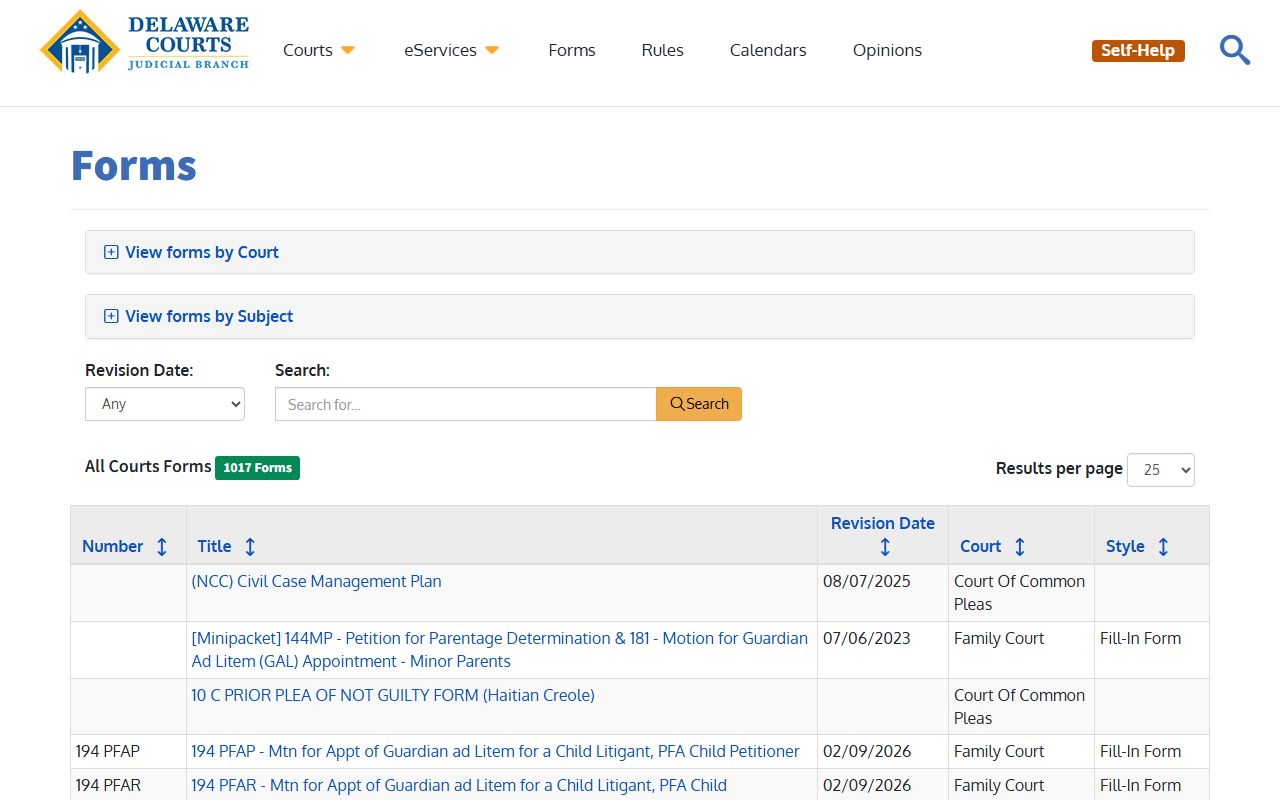
Most forms need a signature. Some need notarization. Instructions come with each form.
Key forms for criminal records work:
- ADM_ADM_03_A: Application for Access to Superior Court criminal files
- MISC35: Application for Access to Court Records in Justice of the Peace Court
- CRF35: Criminal Case Continuance Request Form
- CF49: Application and Affidavit to Proceed In Forma Pauperis (fee waiver)
- MCR35: Request for Modification of Criminal Sentence
- PRO35: Motion for Probation Modification or Early Termination
Expungement forms sit in a separate category. A successful expungement seals the case from public view. The underlying data stays in DELJIS for official use only. Fee waiver forms help people who cannot afford the copy charge. You file Form CF49 with your request and show income details. The court reviews and decides.
Note: Most Delaware criminal court records requests still need an in-person visit to the courthouse where the case was heard. Forms start the process but do not end it.
Court Locations Across Delaware
Three county courthouses handle most Delaware criminal court records. Each has a Superior Court, a Court of Common Pleas, and a Prothonotary's office. The courts share the same hours: Monday through Friday, 8:30 AM to 4:30 PM. Security screens at the door. Cell phones are not allowed in the Sussex County Courthouse.
The Delaware Courts locations page lists every courthouse and its hours.
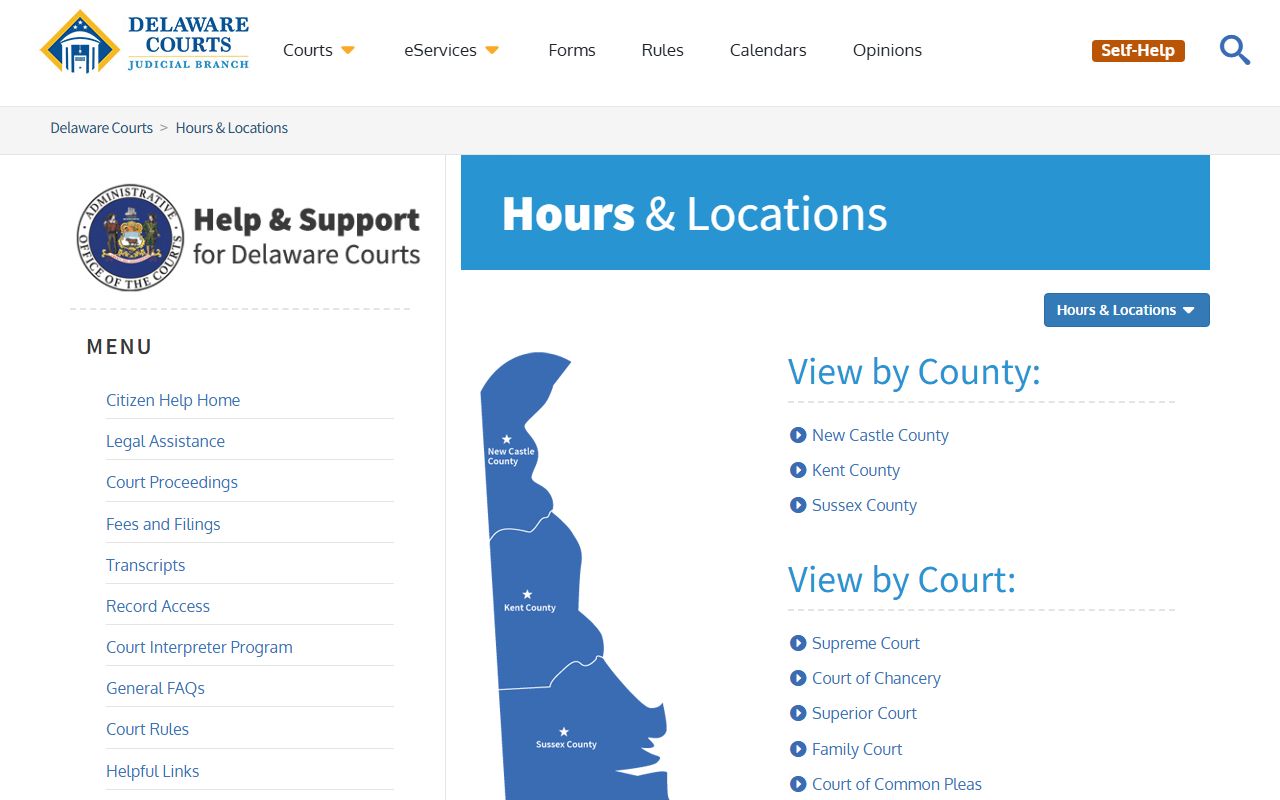
Public access terminals at each site need an appointment. Call 24 hours in advance. Staff can help you find the right docket, but not read the case for you.
County seats for court records:
- New Castle County: Leonard L. Williams Justice Center, 500 N. King Street, Wilmington, 302-255-0800
- Kent County: 414 Federal Street, Dover, 302-735-1900
- Sussex County: 1 The Circle, Georgetown, 302-855-7055
Justice of the Peace Courts run 17 locations across Delaware. These smaller courts hear minor cases and issue search warrants. JP Court criminal records live at the specific JP Court where the case was heard. Not every JP Court has online access tools. A phone call saves a wasted trip.
Delaware Public Archives and Retention
Some Delaware criminal court records leave the courthouse and move to the Delaware Public Archives. Old cases, long-closed files, and historical records live at the archives in Dover.
The Delaware Public Archives home page has a search catalog for these older records.
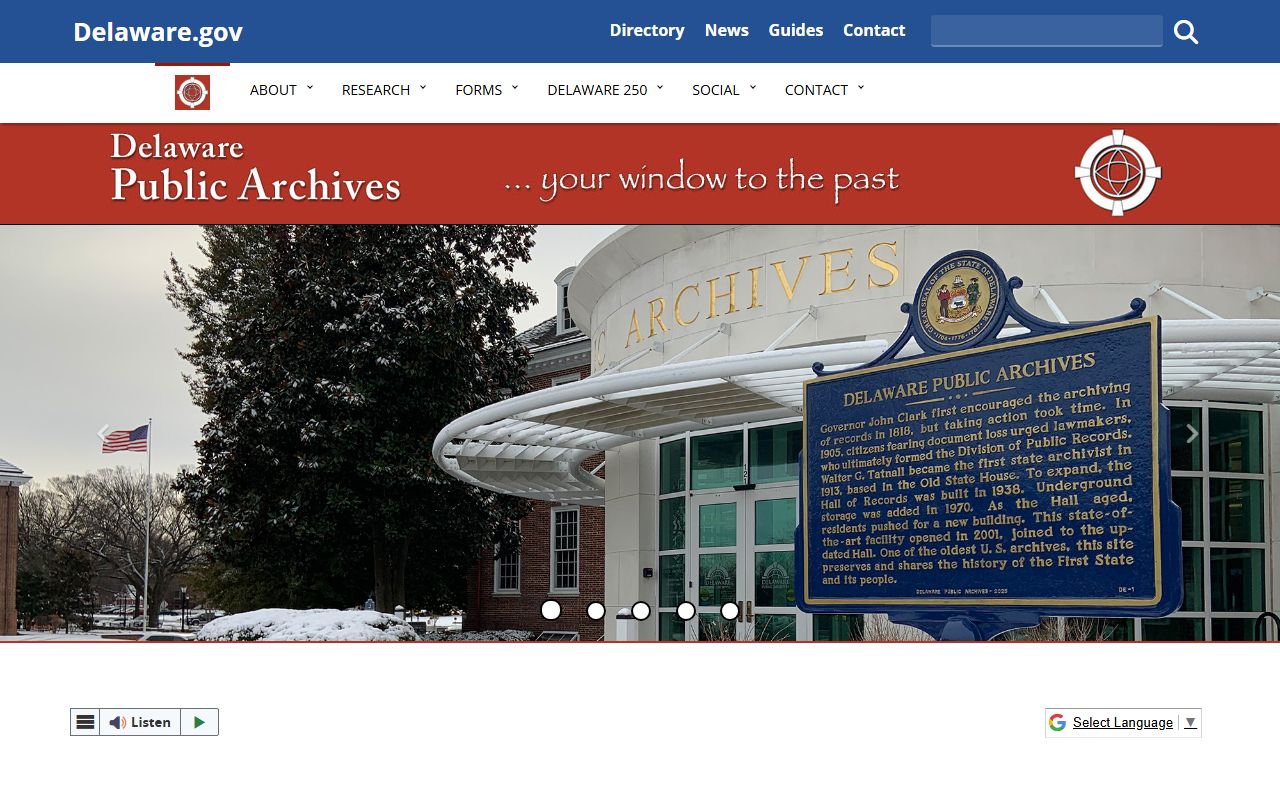
The archives sit at 121 Martin Luther King Jr. Blvd. North, Dover, DE 19901. Call 302-744-5000 or visit the research room Monday through Friday, 8:00 AM to 4:15 PM.
Retention rules matter for Delaware criminal court records. Class A and B felony cases stay on file for 25 years. Class C through G felonies stay for 15 years. Class A misdemeanors hold for 10 years. Class B misdemeanors hold for 7 years. Violations hold for 3 years. Arrest records without charges stay for 3 years. Sex offender registration records stay for life for Tier III, 25 years for Tier II, and 15 years for Tier I. Dockets and case indices stay forever.
Public Access to Criminal Court Records
Delaware public records law lives in Title 29, Chapter 100 of the Delaware Code. This chapter is the Freedom of Information Act, known as FOIA.
The Delaware Code chapter on public access lists the rules that every public body must follow.
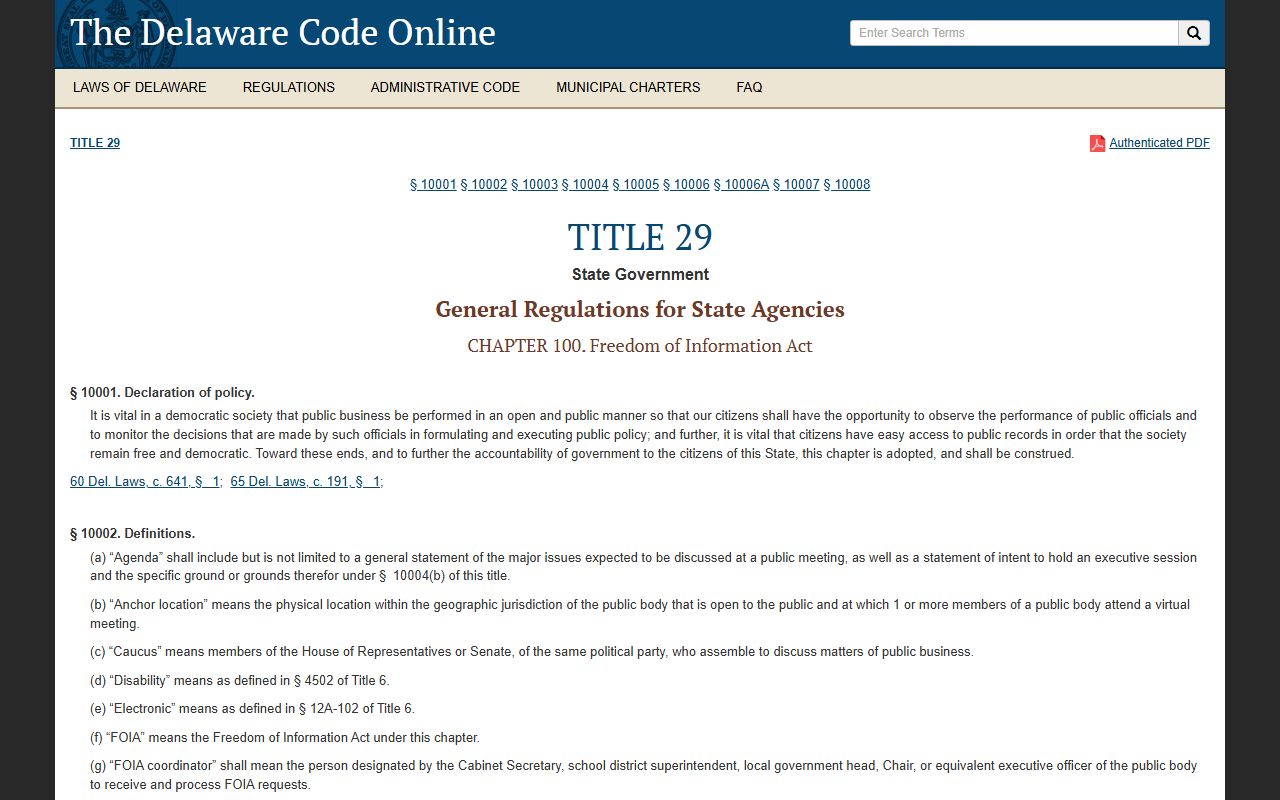
Section 10001 sets the policy that public business must be open. Section 10002 has the list of what counts as a public record, and what does not. Section 10003 sets the 15 business day response time. Section 10004 lists exemptions.
Here is the key rule for criminal files. Under 29 Del. C. § 10002(l)(4), criminal files and criminal records are exempt from FOIA disclosure. The exemption covers active investigations, grand jury work, and most police files. Court dockets and filed case papers are still open at the courthouse under court rules, not FOIA. This is why you need to ask the Prothonotary, not a FOIA officer, for a case file.
If a FOIA request gets denied, you can appeal. The Delaware Attorney General handles most FOIA disputes.
The Attorney General Public Trust Division handles complaints about records access and police conduct.
An appeal goes to the AG within 60 days of the denial. The Civil Rights and Public Trust section also reviews police use of force cases. This adds a second layer of review for serious criminal matters.
Browse Delaware Criminal Court Records by County
Each of Delaware's three counties keeps its own set of criminal case files. Pick a county below to find the Superior Court address, Prothonotary hours, sheriff contact, and local request tips for criminal court records in that area.
Delaware Criminal Court Records by City
Most Delaware cities run a local police department that handles arrests and local reports. The county Superior Court still hears the criminal case after arrest. Pick a city below to find the police records unit, fees, and local FOIA contacts for criminal court records in that city.